
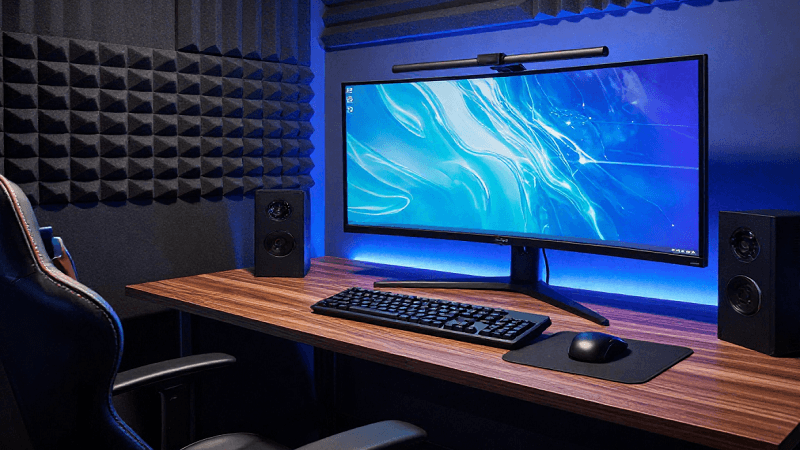
Gaming audio helps players locate footsteps, follow dialogue, react to environmental cues, and feel more immersed in the world of the game. A well-designed sound environment can make a quiet corridor feel tense, a racing game feel more physical, or a cinematic scene feel more emotionally present.
Poor room acoustics can make even expensive speakers feel disappointing. Hard surfaces such as bare walls, windows, desks, and floors reflect sound back into the room, which can blur detail and weaken stereo imaging. Treating early reflection points helps improve clarity and sound localisation, especially in rooms used for gaming, home studios, or home theatres.
Bass also creates problems in smaller gaming rooms. Low frequencies from explosions, engines, and soundtracks can build up in corners and make the room sound boomy or muddy.
Control Echo With Acoustic Panels
A gaming room often sounds unclear because sound does not stop after it leaves the speakers. It hits nearby surfaces, reflects back into the room, and reaches the listener slightly after the direct sound. These early reflections can blur detail and weaken stereo clarity, especially in smaller rooms with close walls and hard furniture.
Echo and reverberation create different but related problems. Echo sounds like a delayed repeat, while reverberation feels like sound lingering in the room after the original sound has stopped. In a gaming setup, this can make dialogue less clear, footsteps harder to locate, and environmental effects less defined.
Bare walls, desks, windows, and hard floors make the problem stronger because they reflect sound instead of absorbing it. These reflections can make voices, gunfire, menu sounds, and high-frequency effects feel sharper or more tiring during long sessions.
Acoustic panels reduce these reflections by absorbing part of the sound energy before it bounces back into the room. This improves clarity during gameplay, streams, and voice chat. Players hear dialogue more clearly, teammates hear less room echo through the microphone, and stereo cues become easier to follow.
Panels usually help most at:
- Side wall first reflection points;
- The wall behind or near the speakers;
- The back wall behind the listening position;
- Ceiling reflection points above the desk or seating area.
For example, a gamer using desktop speakers may hear dialogue bouncing off a bare side wall. Acoustic panels placed at the first reflection points can reduce that bounce, make voices clearer, and improve the sense of direction in the game.
For more demanding setups, professional acoustic treatment services can help identify the right panel positions, surface coverage, and material choices for the room size, speaker layout, and gaming style.
Tame Boomy Bass With Bass Traps
Bass behaves differently from mid and high frequencies because low-frequency sound waves are much longer. This makes them harder to control with thin acoustic panels. Standard panels often manage speech-range reflections well, while bass traps target the longer wavelengths that build up inside rooms.
In gaming rooms, this matters because subwoofers, large speakers, and soundbars can overload small spaces. Low frequencies reflect between walls, floors, and ceilings, creating areas where bass feels exaggerated and areas where it almost disappears. This uneven response can make explosions, engines, and cinematic music sound muddy instead of powerful.
Small rooms often make the problem more noticeable. Room modes and standing waves exaggerate certain bass notes while hiding others. A player may hear one explosion as overwhelming, then hear another low-frequency effect as weak, even though the game audio itself is balanced.
Bass traps help smooth the low-frequency response by absorbing excess bass energy. They reduce low-end buildup, shorten bass decay, and make the room sound more controlled. Corners usually matter most because low-frequency energy tends to accumulate along room boundaries, and corner bass traps use that position to absorb bass more effectively.
A player may turn down the bass because explosions sound too heavy in the room. After adding bass traps, the same soundtrack can feel powerful but cleaner, because the room no longer exaggerates the low end.
Improve Speaker Placement Before Adding More Gear
Speaker placement, chair position, desk location, and distance from walls all affect what the player hears before any panels or bass traps enter the room.
Start with the listening position. The player should sit where the left and right speakers reach both ears evenly. A common setup uses an equilateral triangle, where the distance between the two speakers matches the distance from each speaker to the listener. This helps create a stable stereo image and makes directional cues easier to judge.
Before adding more gear, check the basics:
- Place the main seat in a balanced position between the left and right speakers;
- Keep both speakers at the same height, ideally around ear level;
- Angle the speakers toward the listening position;
- Avoid placing one speaker closer to a side wall than the other;
- Keep the desk or chair away from the rear wall when possible, because nearby boundaries can exaggerate bass.
Symmetry matters because the brain compares sound from the left and right channels to understand direction. If one speaker sits closer to a wall or points at a different angle, reflections reach the listener unevenly. This can make footsteps, voices, and movement cues feel less accurate.
Acoustic specialists often treat speaker and listening position as the foundation for the room, because they influence both low-frequency balance and stereo clarity.
Use Soft Furnishings to Support Acoustic Treatment
Soft furnishings cannot replace proper acoustic panels in a demanding setup, but they can reduce harsh reflections and make the room feel more comfortable. Acoustic guidance often recommends carpets, curtains, upholstered furniture, and panels because soft, porous materials reduce reflections and shorten reverberation.
Useful additions include:
- Rugs that reduce floor reflections, soften footsteps, and limit chair noise on hard flooring;
- Curtains that soften reflections from windows, especially when the fabric is thick and full-length;
- Upholstered furniture that absorbs part of the mid and high-frequency energy in the room;
- Bookshelves or uneven shelving that break up flat wall surfaces and scatter reflections instead of sending them straight back into the room;
Soft furnishings improve room acoustics, but they do not soundproof the room. They mainly reduce reflections inside the space. If the goal is better gaming sound, they can support acoustic treatment. If the goal is to stop sound from entering or leaving the room, the room needs dedicated soundproofing measures.
Balance Absorption and Diffusion for a More Immersive Room
A gaming room should sound controlled, not lifeless – meaning that there is such a thing as too much acoustic treatment. An unnecessary amount of thin foam can reduce high-frequency reflections, but it often leaves low-frequency problems untouched. The result may sound dull at the top end and still muddy in the bass.
A better setup combines different types of acoustic treatment:
- Absorption reduces excessive reflections from walls and ceilings, which helps dialogue, effects, and voice chat sound clearer;
- Diffusion scatters sound instead of absorbing it completely, which helps the room feel more spacious and less harsh;
- Bass traps control low-frequency buildup, especially in corners where bass energy often accumulates.
This balance matters because games rely on many layers of sound at once. Open-world games need space and environmental detail. Racing games need engine weight without boominess. RPGs and cinematic titles need clear dialogue, music, and atmosphere. Research from Cornell University on room acoustic rendering for VR and gaming also highlights the role of early reflections, scattering, and reverberation in creating immersion and perceived realism.
Good acoustic treatment helps gamers hear more of what the game actually delivers. Dialogue becomes easier to follow, directional cues become more reliable, and long sessions feel less tiring because the room no longer adds as much echo, harshness, or low-end confusion.